64 years and counting
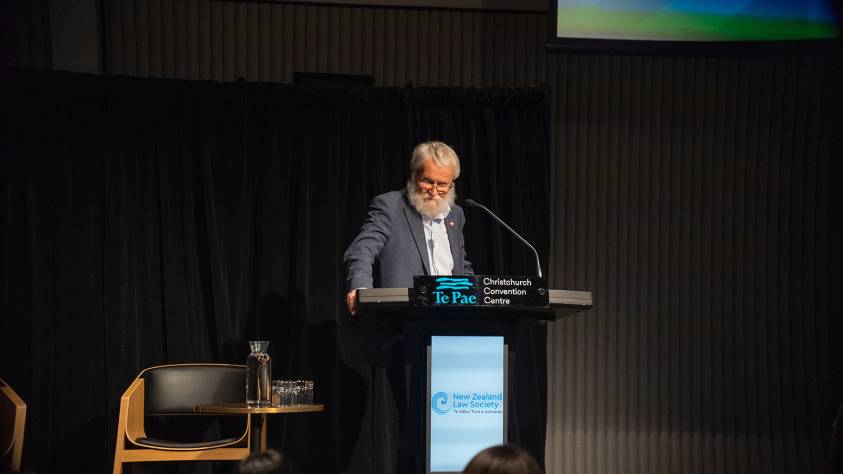
Nigel Hampton KC reflects with LawTalk on a legal career defined by purpose, public service, and a willingness to stand firm in the pursuit of justice.

Over more than six decades in the law, Nigel has witnessed – and helped shape – some of New Zealand’s most significant legal moments. His work has touched cases that have left a lasting mark on the national conscience, from Peter Hugh McGregor Ellis v R to Osborne v WorkSafe New Zealand, arising from the Pike River tragedy.
Across that time, he has seen not only landmark cases, but deep changes in the profession itself. Running through it all is a clear thread: a conviction that the law matters most when it improves lives and strengthens justice.
Reflecting on the profession today, Nigel is alert to the pressures facing democracy and the rule of law. He points to troubling developments in some overseas jurisdictions, and to signs that similar attitudes are beginning to reverberate in New Zealand. “I think of our own growing disrespect for conventions, both national and international, and the degradation of rules-based systems both abroad and at home,” he says.
That perspective has informed his career-long approach: when the chance arises to do some good – or to create positive change – it should be taken.
When he began practice in the 1960s, legal aid in the Magistrates’ Courts operated under the Offenders Legal Aid Act 1954. “Even the name lacked lip service to the presumption of innocence,” he notes.
Because legal representation depended on the discretion of a Magistrate or Judge, access to justice was uneven and uncertain. That experience helped drive his support for the duty solicitor scheme in the early 1970s.
“It started in Christchurch as a voluntary effort, with plenty of lawyers willing to help and strong support from the magistrates. From there, it spread across Canterbury, then to Nelson and further north, eventually becoming an accepted part of our criminal justice system.”
He describes the scheme as an important step toward balancing the power of the state and ensuring a fairer process for those most often before the courts.
“The disadvantaged and indigenous, who were then, as now, so frequently one and the same.”
More recently, he points to the creation of the Criminal Cases Review Commission as another milestone – one that followed decades of advocacy by him and others. He traces that commitment in part to the Peter Ellis case, in which the Supreme Court posthumously quashed Ellis’ convictions more than two decades after he had spent seven years in prison maintaining his innocence, and to a hostage-taking incident at Christchurch Men’s Prison in 1997, which sharpened concerns about miscarriages of justice in high-profile cases.
Relationships, too, have shaped Nigel’s career in unexpected ways.
After the Pike River explosion in 2010, he was approached by Andrew Little, then General Secretary of the Miners’ Union, who asked him to represent the union in the Royal Commission.
Andrew had recognised him from a litigation skills course years earlier. That connection led to his involvement in the Commission and, ultimately, to years of Pike River litigation, where he acted pro bono for families of the victims through multiple proceedings. It culminated in a successful Supreme Court challenge, Osborne & Rockhouse v Ideas and ideals WorkSafe New Zealand, which found the agreement to dismiss health and safety charges unlawful. The case even brought the unusual experience of seeing himself portrayed on screen in the film Pike River.
“You never can expect the fruit which connections may bear.”
A similar lesson emerged beyond the courtroom, where a chance meeting led to a decade of voluntary service on the KidsCan board, helping the organisation grow into the significant contributor it is today.
“When opportunities present themselves, take them,” Nigel says. “Pro bono publico is a worthwhile guiding principle to be remembered and acted upon by all lawyers.”
For Nigel, the practice of law has been both privilege and a calling – work that has brought colour, drama, and deep satisfaction to his life.
“It has been a life with words, with ideas and ideals. One which has permitted me to attempt in some small way to right the wrongs which I have seen, to try and help remedy the deficiencies apparent within our justice systems.”
His career has been shaped not simply by longevity, but by a sustained sense of purpose: a readiness to step forward, to serve, and to build on hard-won gains in the pursuit of a fairer system.