Book review: Tracing the contours of refugee protection
Barrister Sharelle Aitchison reviews a new book that explores the landmark decisions that have shaped international refugee law.

Editors: Kirsten McConnachie and Sarah Singer. Publisher: Hart Publishing, 2026. Format: Print. Law Library: Auckland.
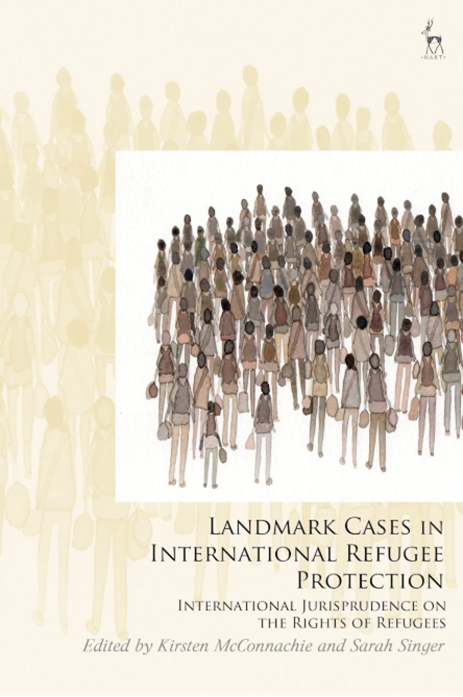
A striking feature of Landmark Cases in International Refugee Protection – International Jurisprudence on the Rights of Refugees is its strong spatial perspective. At the centre of each of its 15 chapters is a landmark decision, positioned in its wider social, political, legal and policy landscape. Of enduring significance, these decisions emanate from national, regional, supranational and UN treaty bodies; feature diverse actors (from judges, counsel, the UNHCR, strategic litigation groups and civil society); and span multiple jurisdictional scales, transcending any single jurisdiction. One seminal example is the case of Teitiota, which began its journey at New Zealand’s Immigration and Protection Tribunal before travelling to the United Nations Human Rights Committee.
Throughout these chapters, the development of fundamental concepts of refugee law are closely studied and situated within the broader constellation of international law that includes international human rights law, international humanitarian law and national constitutional law, amongst others. Historically a doctrine-centric discipline, the collection gives even treatment to the refugee definition, refugee rights (such as, the principles of non-penalisation of illegal or irregular entry and of non-refoulement) and to different aspects of refugee conditions and protection (encompassing maritime governance, interdiction at sea, and securitisation). Its contextual clarity, focus and short story-like character (where chapters may be consumed on the bus, the space of a lunch break, or just before bed) transforms the potential for a static, textbook read into a dynamic living system – as akin to the law.
If any critique could be made, it is simply that there are not enough chapters to reflect upon. A lingering question is how does one qualify a “landmark” and for how long. As the opening author Hugo Storey (a landmark judge and scholar in his own right) remarks, “sooner or later all landmark cases become ruined temples”.