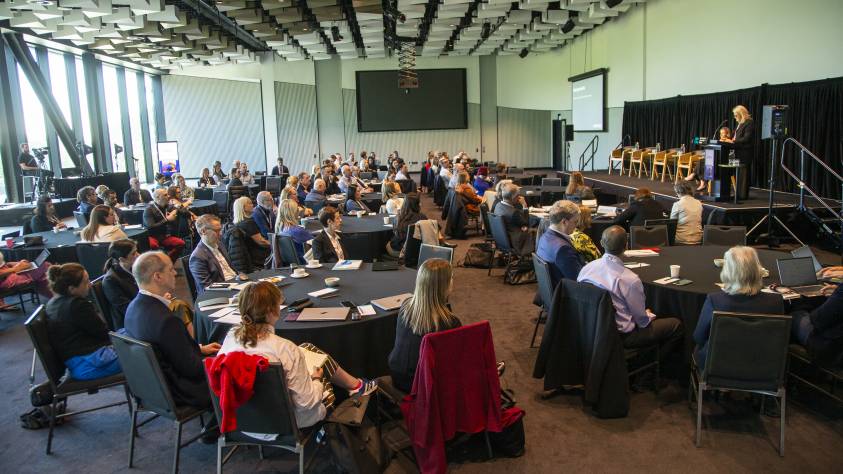
Conference sessions included restoring wellbeing and competence through rehabilitative penalties. Discussions centred around whether there could be conditions to support public safety and that rehabilitative penalties such as education, supervision, health assessments or interventions which could be beneficial for both practitioners and society.
Deputy Chair of the Lawyers and Conveyancers Disciplinary Tribunal Dr John Adams observed that in some cases a generally sound lawyer has done a foolish thing or made an error. From the Tribunal's perspective, he said that insight was key. “There is redemptive power when a lawyer acknowledges wrongdoing and makes an apology. It can take a lot of sting out of the situation. Where practitioner is genuinely contrite, the Tribunal will keen to solve something of value.”
Experts in lawyer wellbeing from the Victorian Legal Services Board and Commissioner and the New South Wales Law Society shared their approaches to tackling wellbeing, and how legal systems and institutions could play a role in keeping the profession healthy. Researcher Nicki Macklin detailed her business case for kindness - how it can mean direct and robust rather than “nice”, and how it can help build organisational cultures which pull people together.
Chief Justice Dame Helen Winkelmann also reflected on wellbeing in her keynote address: “There is serious stress with workload demands, intense scrutiny, confronting information, clients with complex needs and incidents in courts.
“We need to have a workforce that is able to support the administration of justice that can stay well as it does so. A workforce that is stressed can't do that.” She commended the work that is being done in the profession on lawyer wellbeing, noting that poor wellbeing can sometimes lead to conduct issues.
Cultural competency in Aotearoa New Zealand was highlighted in a presentation by barrister Chris Merrick in a session that discussed regulating from a te Ao Māori perspective. Real Estate Authority Chief Executive Belinda Moffat shared the Authority’s experience with setting cultural competency expectations.
Law Society Chief Executive Katie Rusbatch noted in her opening presentation that as regulators of the legal profession, legal regulators are caretakers of legal practice and protectors of legal consumers for future generations. "To be true stewards of how the profession is regulated, and to equip the profession with the tools it needs to thrive in the future, we must look ahead — and we must innovate.
“We must evolve as societal thinking evolves, as the law evolves, and as the practice of law itself evolves.”
Delegates explored a wide range of issues affecting us all as regulators including how to respond to the challenges of social media and AI, how to navigate the boundaries between personal and professional conduct and how to support lawyers through disciplinary action through rehabilitative pathways. The Australian contingent were all ears when John Sneyd from the Department of Internal Affairs led the discussion on anti-money laundering. “It boils down to knowing some key things: who your clients are, and where their money is coming from.”
The conference was a fantastic opportunity to share knowledge, extend relationships with our trans-Tasman counterparts and showcase not only the work being done in Aotearoa New Zealand, but our rich cultural landscape. Delegates experienced warm manaakitanga from Ngāi Tūāhuriri, and infusion of te ao Māori into many aspects of the event, making it a uniquely Kiwi experience.