Progress towards timely access to justice
Chief District Court Judge Heemi Taumaunu discusses recent initiatives in the District Court criminal jurisdiction to improve timely access to justice.

Improving timely access to justice is a top priority for the District Court of New Zealand – and for the whole court system. Before I outline the work that is going on, I first want to acknowledge the high workload and pressure on counsel who appear in the District Court, the biggest court in Australasia. The Chief Justice in her annual report has spoken about the pressure the justice system is under and referenced in particular the impact on the legal profession. I concur. Our timely action initiatives have to be balanced by empathy and constant attention to the wellbeing of everyone associated with the court and I can assure you that the profession is front of mind.
I am sure you will be reassured that the approach we are taking to timely access to justice in the District Court is a continuation of the approach that was developed in full collaboration with the leaders of the profession in the middle of Covid, when the Criminal Process Improvement Programme (CPIP) initiatives were first under development.
The essential principle behind the District Court approach to timely access to justice is to ensure, where possible and appropriate, meaningful progress towards disposition is made at every court event. This is the opposite of churn, when no progress is made and cases are adjourned to repeat the same step in the process.
Our pursuit of timely access to justice is not the pursuit of timeliness for its own sake. In the interests of justice there may well have to be occasions where no progress is made and the step needs to be repeated. The interests of justice may require it. District Court judicial officers are bound to apply the relevant law but within those boundaries, you can expect them to be seeking to make meaningful progress where it is appropriate to do so.
As long as it is appropriate and lawful, this approach benefits all involved. From the point of view of the legal profession, it means you can see meaningful progress being made. Hearings will be available earlier and delay reduced. That should lead to a more satisfying professional experience, rather than a frustrating day in court where no progress was made because of system-wide issues.
The District Court has made significant progress with timely access to justice: at the end of July 2025 there were 6660 criminal cases in backlog nationally, down 26.7% since the peak of more than 9000 in January 2022. Timely disposal of criminal cases in the District Court has remained stable at 81% since early 2024 and if we continue with the measures we have in place, it is on track to reach 90% by mid-2027.
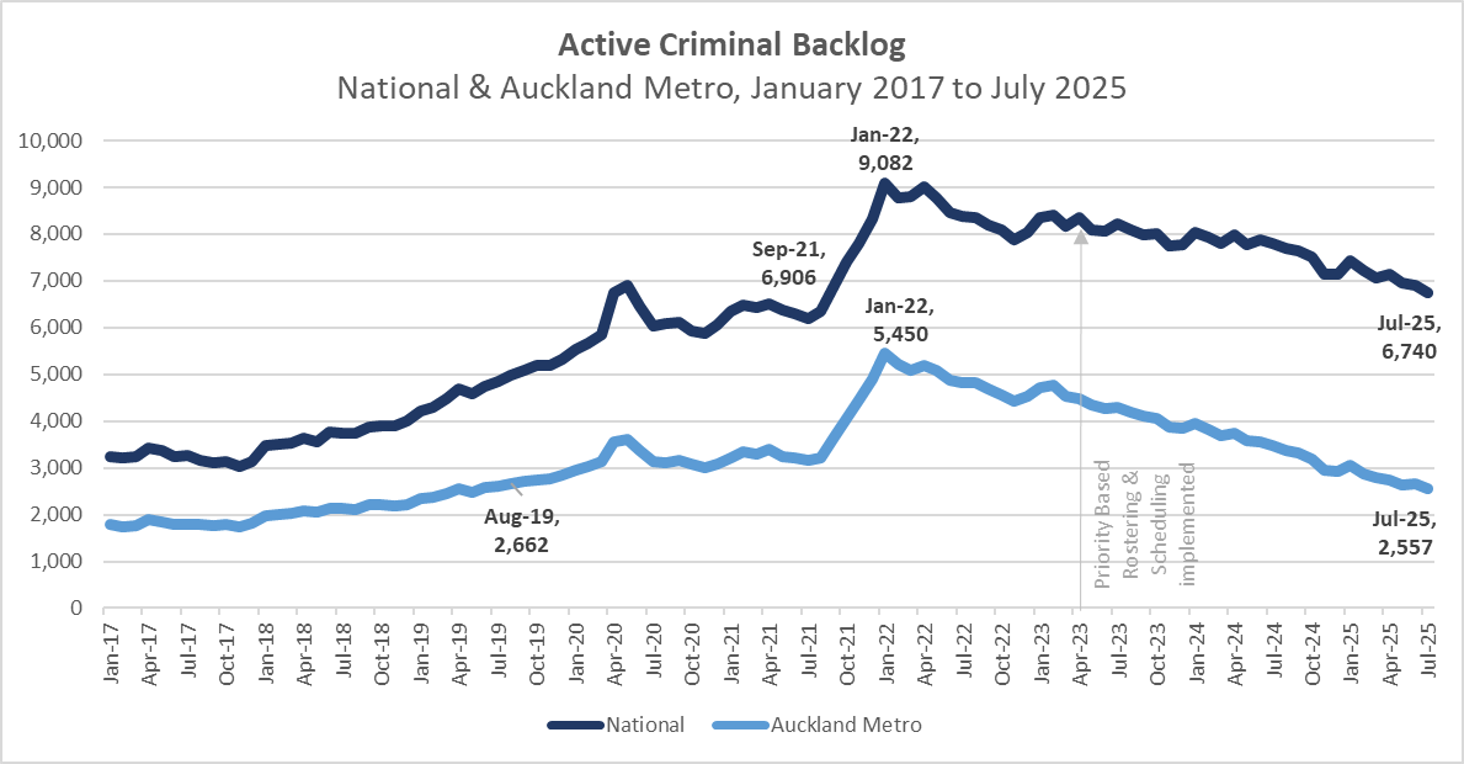
Since 2023, we have put in place a raft of measures to bring backlogs back under control, improve the timeliness of cases going through court and address the overall effectiveness of court processes.
In 2023 we introduced priority-based rostering and scheduling, which means allocating the judicial resource to where the need is greatest. At that time, half of all criminal backlog cases were located in the six Auckland Metro courts, so that is where more of the judicial resource went.
I know the extra court hearings in Auckland were challenging for counsel and justice sector agencies to adjust to and it took a lot of discussion and goodwill to work through. Priority-based rostering and scheduling is now our way of doing things and we are constantly looking at the national picture to decide how to employ judicial resource to best effect.
In 2024 I issued the Timely Access to Justice Protocol, setting out a standard of 90% of criminal cases disposed of within category-based timeframes or thresholds. For example, the protocol states that category three judge-alone trials should be heard and determined within nine months, and category three jury trials within 15 months.
In each category the thresholds set out realistic timeframes for most cases to progress from first appearance to disposal, and seek to strike the right balance between aspirational objectives and operational realities. The 90% standard also makes allowance (10%) for those highly complex cases that are unlikely to be disposed of within the applicable timeframe.
Some of the case-management practices that contribute to more meaningful court events are:
We are also continuing to focus on the criminal case backlog. Timely access to justice concerns are just as real for people whose cases are in backlog, or even more so, as for those with new cases before the court.
In plain language terms, our timely justice strategy is two pronged, balancing distinct but connected strands of work. First, ensuring as much as possible that 90% of new cases are finished within the relevant category-based timeframe. And second, simultaneously reducing existing backlogs with a particular focus on hearing and determining our most serious backlog cases at the earliest available opportunity.
As the graph above shows, we are making steady progress reducing delays and backlogs. There is still room for improvement and there is a lot left for us to do. I extend my sincere gratitude to the profession and to those lawyers who regularly appear in the District Court for their ongoing efforts to support the District Court to provide timely access to justice for all.