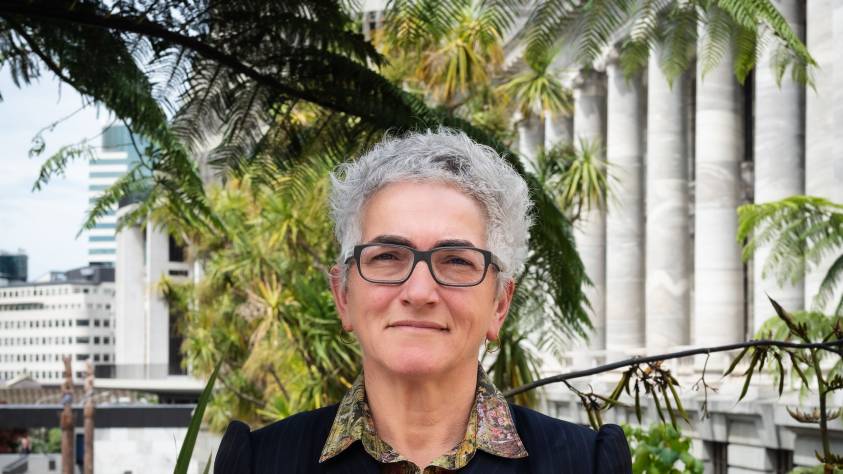
After 10 years as Solicitor-General Una Jagose’s departure marks the end of an era. In LawTalk, she reflects on her time in the role and the importance of collective responsibility in public service.
To mark her final day in the office, outgoing Solicitor-General Una Jagose swapped her usual business suit for a whimsical jacket and shorts set, emblazoned with a map of the world. It was a light and fitting gesture to close out 10 formidable years at the pinnacle of Aotearoa New Zealand’s legal leadership – a period that spanned three government administrations and some of the most complex and challenging moments in recent public life.
Ms Jagose tells LawTalk her success in the job of ensuring Government operates according to law was never a solo undertaking.
“As the whakataukī goes, ehara taku toa i te toa takitahi, engari he toa takitini; My strength is not that of an individual but that of the collective.
“My pitch at the interview ten years ago was that the Solicitor-General should actively leverage the Government Legal Network, because that is what truly strengthens the role. To ensure that you have impact where it is most needed, you need to know where to look – across the many agencies and functions of the Crown. One of the great features of our system is that the Solicitor-General sits at the centre of the public service, which gives you that advantage.”
Modernising Crown Law
She is proud of the Crown Law she leaves behind, one that is more agile, less “ivory towered”, and clearer about its purpose. This is a journey she notes was underway when she was appointed Solicitor-General in 2016.
Over time, it has shifted away from the traditional model where a problem is presented, and lawyers are expected to deliver one definitive answer, cast as a legal opinion (often long, heavily referenced and footnoted).
“Decision making moves fast now – so our influence relies on us being agile about what form our legal services take.
“We have become a Crown Law that asks ‘how can we help you take your next step, lawfully? And we are clear about what we are expert in – constitutional, criminal, Te Tiriti/Treaty and public law issues. We leverage the wider network or the private sector for other expertise the Crown needs.”
People-focused leadership
She’s also encouraged by how the Government Legal Network and the Crown Solicitor Network have matured into coherent, collaborative groups that readily share support, expertise, and resources.
“There’s now more recognition than ever that the Solicitor-General is the professional head of the Government Legal Network. Yes, they have employment obligations to their chief executives, but they also have fundamental obligations to the rule of law – and those duties ultimately come through to the Solicitor-General. Among chief legal advisers and the wider network of government lawyers, that is now very real.”
On her first day in the top job, she told staff she wanted Crown Law to be a place people wanted to be, not just because of fascinating legal work, but because it is meaningfully committed to respect for people, as much as it is committed to respect for the rule of law.
“My mantra has always been, how we work together is as important as what we do.”
The COVID-19 experience
Four years into the role, that mantra was to be put to the test.
The pandemic brought intense pressure and required fast, sound decision making and, therefore, fast and sound legal advice. It required collaboration across disciplines.
In the early days of the lockdown, Ms Jagose received a call from a group of legal academics who “offered to help us in keeping pace with the myriad legal issues emerging”. Their generous offer of time and expertise was gratefully accepted.
“It meant we could keep pace with the advice needed but also look ahead to what would be needed next, and into the future. We were able to bring order to the legal underpinnings more quickly,” she says.
That support meant Crown Law didn’t have to scramble alone to keep up.
“It was such a gift to have people offer confidential support, rather than simply putting opposing legal views out into the public arena. It meant we could work together – not always agreeing with each other – but with the shared aim of delivering something very important.”
They were heady, challenging times, she says, remembering endless Teams calls with departmental Chief Legal Advisors, and her own Office’s senior lawyers nutting things out in quick time, knowing decisions would be pored over, including by the Courts and the Regulations Review process.
“That kind of pace and pressure might freeze you, but we just had to register it and keep going. We were using the 1956 Health Act that was designed without a pandemic in mind to put a whole country into lockdown but maintain essential services in 2020.
“We had to keep moving, respecting the Court’s role in scrutinising on review of the use of executive power, doing our best to advise on the right orders to be put in place, and on we went.”
Not everything went well. The High Court later found the first nine days of lockdown were unlawful, in that they were not supported by an appropriate order.
Learning under scrutiny
The scrutiny that comes with such a high-profile role can be difficult, even with strong support, she says. As well as COVID-19, giving evidence at the Royal Commission of Inquiry into Abuse in Care and Faith Based Institutions was particularly challenging.
“It was important for the Solicitor-General to be present before the Inquiry when it examined the Crown’s redress and litigation practices. I accepted that some things had been done badly by the Crown’s lawyers and that, in other aspects, the Crown’s lawyers were not the decision makers but following instruction. Sometimes the criticism was personal. A big lesson for me is that when a case is on our desks, we’ve got people’s lives in our hands. It is easy to get caught up in legal argument, but we have to recognise there is a person on the other side, at one of the most vulnerable points in their life. Lawyering with sympathy and humanity is something I have led very purposefully.”
The profession ahead – conduct, AI and public trust
Ms Jagose says the profession must keep building knowledge of and respect for tikanga in law; retain momentum against sexual misconduct and misogyny within our profession; and use AI to benefit the administration of justice.
More broadly she sees a growing onus on role holders to uphold the rule of law and access to justice at a time when people are growing more sceptical about institutions.
“It’s not necessarily a bad thing that we’ve moved away from assuming people in office must be right but there has been a much faster shift towards doubting role holders and questioning the legitimacy of courts and Government institutions.
“That means we must keep speaking about why the rule of law and why democracy matter. I’m not the first to say let’s get civics into schools. We need a better-educated citizenry, not cynical, but engaged; willing to participate and to challenge.”
“We must continue to see Government operating according to law, and courts remain independent, delivering justice as they see it. And we must protect those institutions. The challenges to legitimacy will keep coming, and role holders like the Solicitor-General have a crucial part to play.”
Looking ahead
Next up for Ms Jagose is a well-earned break, before joining Clifton Chambers, Wellington in May.
Whoever follows in the role, she knows they too can lean on the people around them for the support needed.
“It can be lonely but less so with good people around you.
“I feel great. I look back with enormous satisfaction at all we have done in these past ten years; I have been so well supported to do that.”
On being the first woman Solicitor-General Ms Jagose says being the first is not as important as not being the last woman appointed to the role.
“I leave happy to hand over to the next, the 18th, Solicitor-General and wish them well; it’s a great job. I’m excited about my future; I don’t know what it holds but I’m super looking forward to it.”
New Solicitor-General appointed
Anna Adams KC will take up the role of Solicitor-General and Chief Executive of the Crown Law Office on 11 May 2026. She is currently a barrister at Bankside Chambers and has previously held senior leadership and governance roles, including at Meredith Connell and Pharmac.